Categoría: Uncategorized

  • EL FIN DE SEMANA DEL 4 DE JULIO, Y POR QUÉ EL «DESCENSO» NO ES UNA VICTORIA | THE FOURTH OF JULY WEEKEND, AND WHY THE «DECLINE» IS NOT A VICTORY

    EL FIN DE SEMANA DEL 4 DE JULIO, Y POR QUÉ EL «DESCENSO» NO ES UNA VICTORIA | THE FOURTH OF JULY WEEKEND, AND WHY THE «DECLINE» IS NOT A VICTORY

    Por L. Carmen GómezBy L. Carmen Gómez

    Cada verano me obliga a volver a las cifras. No por costumbre, sino porque las cifras son lo único que se resiste a la anestesia con la que este país ha aprendido a convivir con sus propios muertos.Every summer forces me back to the numbers. Not out of habit, but because numbers are the one thing that resists the anesthesia this country has learned to live with alongside its own dead.

    Este año, la prensa titula que la violencia armada del 4 de julio «bajó». Es cierto, en un sentido estrictamente aritmético. Según el Gun Violence Archive, el propio Día de la Independencia dejó 139 tiroteos en todo el país, con 35 muertos y 187 heridos, sin contar a los perpetradores. Es una cifra inferior a la del año pasado, cuando hubo 153 incidentes. Una caída de casi el diez por ciento. En los informes, eso se lee como progreso.This year, the press headlines that gun violence on the Fourth of July «declined.» That is true, in a strictly arithmetic sense. According to the Gun Violence Archive, Independence Day itself left 139 shootings across the country, with 35 dead and 187 wounded, not counting the perpetrators. That is a lower figure than last year, when there were 153 incidents. A drop of nearly ten percent. In the reports, that reads as progress.

    Permítanme ofrecer otra lectura.Allow me to offer another reading.

    Durante el fin de semana festivo, de viernes a domingo, se registraron al menos 347 tiroteos, que dejaron como mínimo 122 muertos y 425 heridos. Ocurrieron por igual en estados de leyes estrictas y en estados de leyes laxas: Texas encabezó la lista con 33 incidentes, seguido de California con 29, Nueva York con 26, Ohio con 22, e Illinois y Pensilvania con 17 cada uno. La geografía política no ofreció refugio a nadie.Over the holiday weekend, from Friday to Sunday, at least 347 shootings were recorded, leaving a minimum of 122 dead and 425 wounded. They occurred equally in states with strict laws and states with lax ones: Texas led the list with 33 incidents, followed by California with 29, New York with 26, Ohio with 22, and Illinois and Pennsylvania with 17 each. Political geography offered refuge to no one.

    Y detrás de cada número hay una escena. En Coney Island, Nueva York, cuatro adultos y cuatro niños recibieron disparos mientras asistían a una comida al aire libre; las víctimas menores tenían entre 6 y 14 años. En San Antonio, Texas, una persona murió y otras cinco resultaron heridas —dos de ellas niños— frente a un complejo de apartamentos donde una familia celebraba la fiesta nacional. En Glendale, Arizona, cinco personas fueron heridas, entre ellas una niña de 8 años. En Mount Clemens, Michigan, otras cinco, incluida una niña de 10 años.And behind every number there is a scene. In Coney Island, New York, four adults and four children were shot while attending an outdoor cookout; the minor victims were between 6 and 14 years old. In San Antonio, Texas, one person died and five others were wounded — two of them children — outside an apartment complex where a family was celebrating the national holiday. In Glendale, Arizona, five people were wounded, including an 8-year-old girl. In Mount Clemens, Michigan, five more, including a 10-year-old girl.

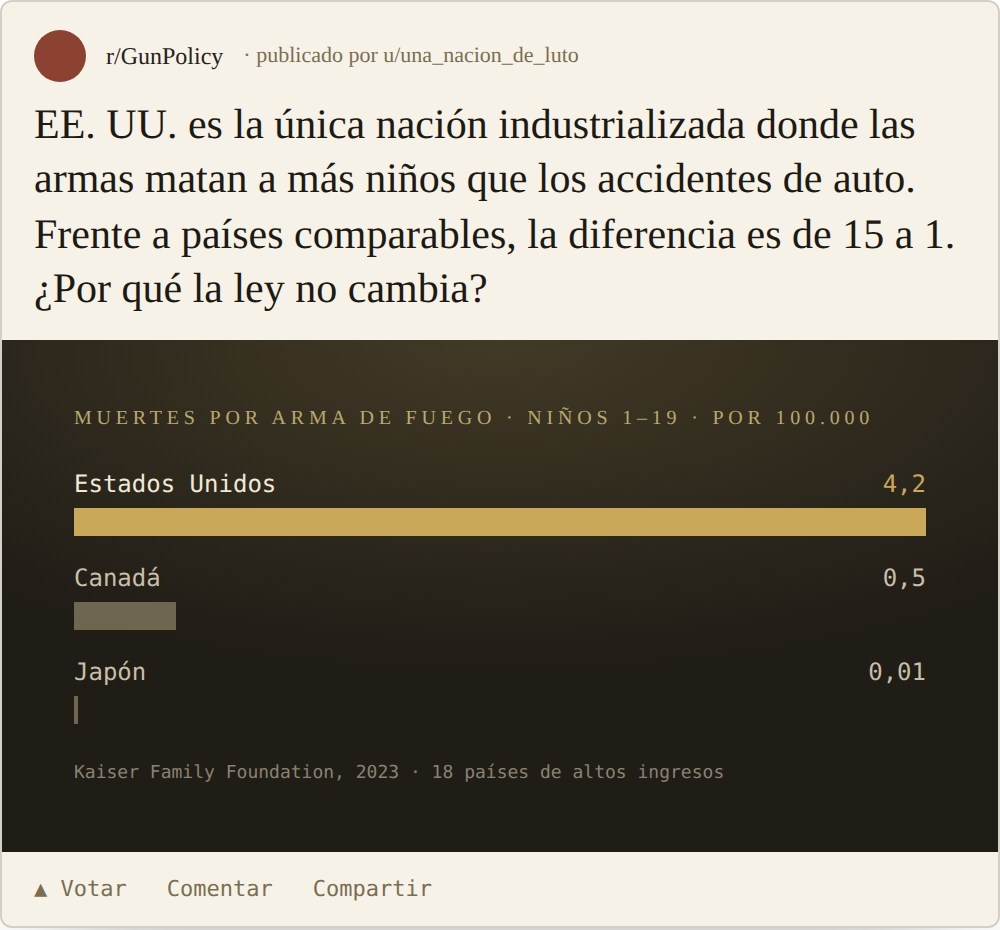
    Esto es lo que quiero que consideremos con seriedad: cuando el punto de partida es tan alto, una reducción del diez por ciento sigue dejando un país irreconocible para casi cualquier otra democracia desarrollada. El descenso es real. El suelo sobre el que desciende es el problema.This is what I want us to consider seriously: when the starting point is this high, a ten-percent reduction still leaves a country unrecognizable to almost any other developed democracy. The decline is real. The floor it is declining from is the problem.

    En lo que va de 2026, Estados Unidos ha sufrido al menos 224 tiroteos masivos, según el Gun Violence Archive. Conviene decir, con honestidad, que las muertes y las lesiones por arma de fuego han bajado respecto al año anterior; el propio archivo señala que los tiroteos masivos han vuelto a niveles previos a la pandemia. No escondo ese dato, porque la credibilidad de cualquier análisis depende de no seleccionar solo las cifras que confirman la tesis. Pero una tendencia a la baja no es lo mismo que seguridad. Un piso más bajo sigue siendo un piso construido sobre pérdidas evitables.So far in 2026, the United States has suffered at least 224 mass shootings, according to the Gun Violence Archive. It is worth saying, honestly, that gun deaths and injuries have declined compared to the previous year; the archive itself notes that mass shootings have returned to pre-pandemic levels. I do not hide that fact, because the credibility of any analysis depends on not cherry-picking only the figures that confirm the thesis. But a downward trend is not the same as safety. A lower floor is still a floor built on preventable losses.

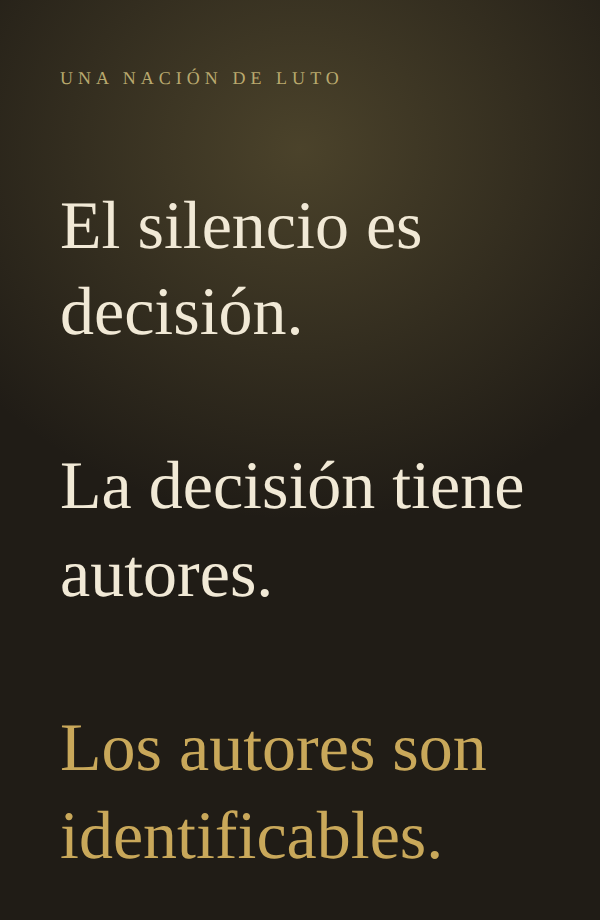
    La repetición no es casualidad. Es el resultado predecible de decisiones legales, regulatorias y políticas concretas, tomadas por personas concretas. El silencio, también, es una decisión. Y esa decisión tiene autores.The repetition is not coincidence. It is the predictable result of specific legal, regulatory, and political decisions, made by specific people. Silence, too, is a decision. And that decision has authors.

    No comparto estas cifras para sumar indignación al ruido de la temporada. Las comparto porque la costumbre de «acostumbrarse» es, en sí misma, una forma de política. Y porque quienes trabajamos con documentos y con evidencia tenemos la obligación de nombrar lo que los titulares suavizan.I do not share these figures to add outrage to the season’s noise. I share them because the habit of «getting used to it» is, in itself, a form of politics. And because those of us who work with documents and evidence have an obligation to name what the headlines soften.

    El duelo, por sí solo, no detiene el próximo disparo. La lucidez sobre las causas, tal vez, sea el primer paso que sí lo haga.Grief, on its own, does not stop the next shot. Clarity about the causes may be the first step that does.

    Fuentes: Gun Violence Archive y The Trace (datos del 4 al 11 de julio de 2026).Sources: Gun Violence Archive and The Trace (data from July 4 to July 11, 2026).
  • NO LO HEREDAMOS DE LOS FUNDADORES: LO CONSTRUIMOS NOSOTROS | WE DIDN’T INHERIT THIS FROM THE FOUNDERS: WE BUILT IT

    NO LO HEREDAMOS DE LOS FUNDADORES: LO CONSTRUIMOS NOSOTROS | WE DIDN’T INHERIT THIS FROM THE FOUNDERS: WE BUILT IT

    Estados Unidos cumple 250 años. El ritual del tiroteo masivo, apenas medio siglo.The United States turns 250. The mass-shooting ritual, barely half a century.

    Por Laigodivis Carmen GómezBy Laigodivis Carmen Gómez

    10 de julio de 2026July 10, 2026

    Estados Unidos cumplió 250 años el sábado. Lo celebró como mejor sabe.The United States turned 250 on Saturday. It celebrated the way it knows best.

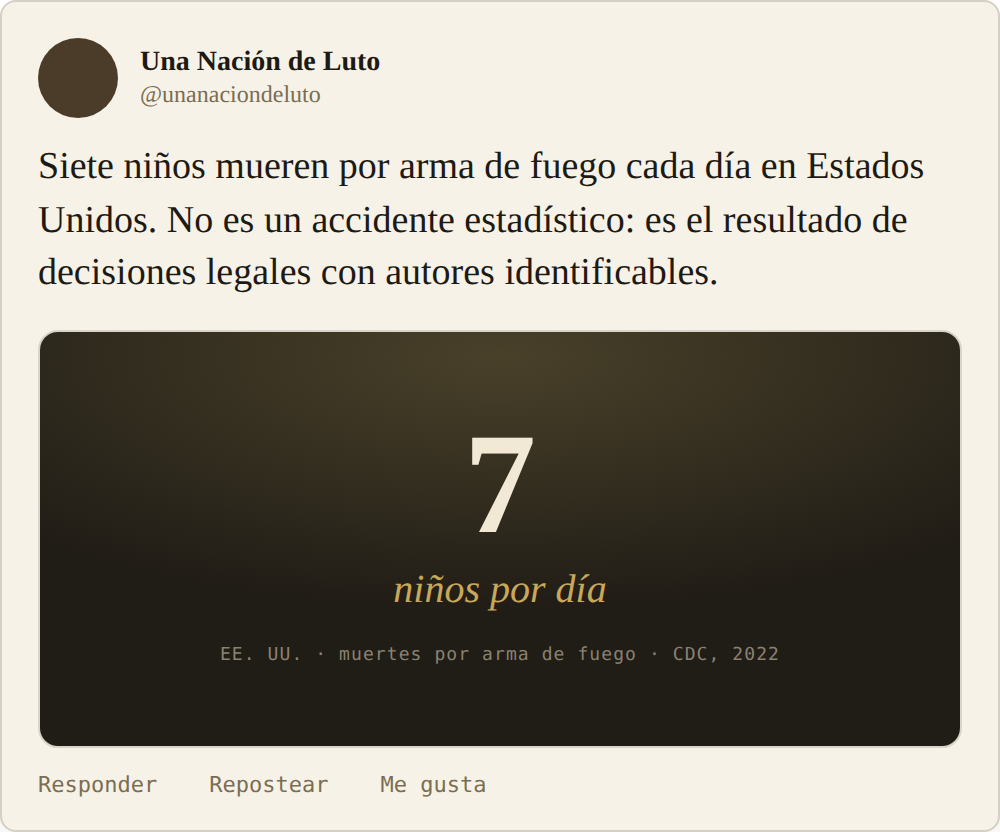
    El 4 de julio hubo 139 tiroteos en el país: 35 muertos y 187 heridos, sin contar a los perpetradores, según Gun Violence Archive. En el fin de semana completo, al menos 347 incidentes con armas de fuego, 122 muertos y 425 heridos.On July 4 there were 139 shootings across the country: 35 dead and 187 wounded, not counting the perpetrators, according to Gun Violence Archive. Over the full weekend, at least 347 gun incidents, 122 dead, and 425 wounded.

    Fuegos artificiales y fuego real. La tradición completa.Fireworks and real gunfire. The full tradition.

    Y aquí viene la parte que deberíamos celebrar, según nos dicen: las cifras bajaron respecto al año pasado. Lo llaman progreso. En Estados Unidos, el éxito en materia de armas se mide así: este año solo murieron 35 personas celebrando la libertad. Descorchen el champán.And here comes the part we’re supposed to celebrate: the numbers went down from last year. They call it progress. In the United States, success on guns is measured like this: this year only 35 people died celebrating freedom. Pop the champagne.

    La liturgia de cada aniversarioThe Liturgy of Every Anniversary

    El guion se repite con una puntualidad casi conmovedora.The script repeats with an almost touching punctuality.

    En Chicago, 21 personas baleadas y 2 muertas durante el fin de semana festivo. En Nueva York, 12 personas heridas de bala en las celebraciones, incluidos varios niños en un tiroteo masivo en Brooklyn — días después de que las autoridades anunciaran el semestre con menos tiroteos jamás registrado. En Gary, Indiana, un niño de 10 años murió por disparos.In Chicago, 21 people were shot and 2 killed over the holiday weekend. In New York, 12 people were shot during the celebrations, including several children in a mass shooting in Brooklyn — days after officials had announced the lowest-shooting half-year on record. In Gary, Indiana, a 10-year-old child died from gunfire.

    Un niño de diez años. El 4 de julio. En el 250.º cumpleaños de la nación.A ten-year-old child. On the Fourth of July. On the nation’s 250th birthday.

    Después vendrá el resto de la liturgia: los thoughts and prayers, las banderas a media asta —que en este país prácticamente ya es su posición natural—, el debate de 72 horas en los medios, y el silencio legislativo hasta el próximo feriado.Then comes the rest of the liturgy: the thoughts and prayers, the flags at half-staff — which in this country is practically their natural position by now — the 72-hour media debate, and legislative silence until the next holiday.

    No es tan viejo como creemosIt’s Not as Old as We Think

    Conviene decirlo con precisión, porque la precisión importa: esta nación no lleva 250 años de luto. El tiroteo masivo moderno —el ataque indiscriminado en un espacio público— es un fenómeno joven. Suele fecharse su nacimiento el 1 de agosto de 1966, cuando un francotirador disparó desde la torre de la Universidad de Texas en Austin y mató a catorce personas: el primer tiroteo masivo en un lugar público transmitido en directo por los medios. Columbine, en 1999, lo convirtió en trauma cultural permanente. Las dos décadas siguientes lo normalizaron hasta volverlo estadística.It’s worth saying this precisely, because precision matters: this nation has not been in mourning for 250 years. The modern mass shooting — the indiscriminate attack in a public space — is a young phenomenon. Its birth is usually dated to August 1, 1966, when a sniper opened fire from the University of Texas tower in Austin and killed fourteen people: the first mass shooting in a public place broadcast live by the media. Columbine, in 1999, turned it into a permanent cultural trauma. The two decades that followed normalized it into a statistic.

    Medio siglo, no dos siglos y medio. Y esa distinción lo cambia todo.Half a century, not two and a half centuries. And that distinction changes everything.

    No es mala suerte. Es arquitectura.It’s Not Bad Luck. It’s Architecture.

    Llevo años estudiando este fenómeno desde el derecho y la política, y la conclusión incómoda es esta: los tiroteos masivos en Estados Unidos no son accidentes que interrumpen el sistema. Son el resultado del sistema. Un sistema donde la violencia armada atraviesa por igual estados con leyes restrictivas y estados con leyes laxas, porque el problema ya no se contiene con fronteras estatales.I have spent years studying this phenomenon through law and policy, and the uncomfortable conclusion is this: mass shootings in the United States are not accidents that interrupt the system. They are the result of the system. A system in which gun violence crosses equally through states with restrictive laws and states with lax ones, because the problem is no longer contained by state borders.

    Un país que convirtió el duelo en rutina administrativa. Que perfeccionó el protocolo posterior a la masacre —comunicado, vigilia, hashtag— con una eficiencia que jamás aplicó a la prevención.A country that turned mourning into administrative routine. That perfected the post-massacre protocol — statement, vigil, hashtag — with an efficiency it never applied to prevention.

    De eso trata mi libro, Una nación de luto / A Nation in Mourning: de cómo la ley, la política y la cultura estadounidenses construyeron —y sostienen— una nación donde el luto se ha vuelto un estado permanente y la masacre, un dato estadístico más entre el desfile y los fuegos artificiales.That is what my book, A Nation in Mourning, is about: how American law, politics, and culture built — and sustain — a nation where mourning has become a permanent state, and the massacre just another statistic between the parade and the fireworks.

    La pregunta que nadie quiere responderThe Question No One Wants to Answer

    Si 122 personas hubieran muerto este fin de semana por agua contaminada, por un fallo aéreo o por un medicamento defectuoso, habría comisiones de investigación, dimisiones y regulación de emergencia antes del viernes.If 122 people had died this weekend from contaminated water, an airline failure, or a defective medication, there would be investigative commissions, resignations, and emergency regulation before Friday.

    Murieron por armas de fuego. Así que habrá otro aniversario el año que viene. Y otro recuento. Y alguien volverá a llamarlo progreso porque los muertos fueron algunos menos.They died from gun violence. So there will be another anniversary next year. And another tally. And someone will call it progress again because a few fewer people died.

    Esta no es la herencia de los fundadores. El ritual del duelo tiene medio siglo, no dos siglos y medio. No lo heredamos de los fundadores: lo construimos nosotros. Y lo que se construye también se puede desmontar — el día que decidamos que doscientos cincuenta años bastan.This is not the founders’ inheritance. The ritual of mourning is half a century old, not two and a half centuries. We didn’t inherit this from the founders: we built it. And what is built can also be dismantled — the day we decide that two hundred fifty years is enough.

    Laigodivis Carmen Gómez
    Autora de Una nación de luto / A Nation in Mourning (2026)
    Laigodivis Carmen Gómez
    Author of A Nation in Mourning (2026)

    #UnaNaciónDeLuto · #ANationInMourning · #ViolenciaArmada · #GunViolence · #EstadosUnidos

  • EL SILENCIO ES DECISIÓN. LA DECISIÓN TIENE AUTORES. LOS AUTORES SON IDENTIFICABLES. | SILENCE IS A DECISION. THE DECISION HAS AUTHORS. THE AUTHORS ARE IDENTIFIABLE.

    EL SILENCIO ES DECISIÓN. LA DECISIÓN TIENE AUTORES. LOS AUTORES SON IDENTIFICABLES. | SILENCE IS A DECISION. THE DECISION HAS AUTHORS. THE AUTHORS ARE IDENTIFIABLE.

    Sobre la normalización de los tiroteos masivos y la responsabilidad de las decisionesOn the Normalization of Mass Shootings and the Responsibility of Decisions

    Por Laigodivis Carmen Gómez · autora de Una nación de lutoBy Laigodivis Carmen Gómez · author of A Nation in Mourning

    Escribí Una nación de luto durante años, y no lograba cerrarlo. Cada vez que creía haber llegado al final, había algo más: otro nombre, otra fecha, otra familia que recibía la llamada telefónica que da inicio a una secuencia ya conocida. En abril de este año decidí que el libro debía cerrarse, no porque la historia hubiera terminado, sino porque comprendí que esa misma imposibilidad de cerrar era parte del fenómeno que el libro examina. El duelo estadounidense por la violencia armada tiene una geometría reconocible y repetida. Lo que no está prefigurado en esa geometría es el cambio. Eso, todavía, hay que construirlo.I wrote A Nation in Mourning for years, and I could not manage to close it. Every time I believed I had reached the end, there was something more: another name, another date, another family receiving the phone call that begins an already familiar sequence. In April of this year I decided the book had to close, not because the story had ended, but because I understood that this very impossibility of closing was part of the phenomenon the book examines. American mourning over gun violence has a recognizable, repeated geometry. What is not prefigured in that geometry is change. That, still, has to be built.

    Y la historia volvió a repetirse. El sistema que el libro documenta no se detuvo el día en que entregué el manuscrito.And the story repeated itself once again. The system the book documents did not stop on the day I turned in the manuscript.

    La frecuencia se ha convertido en rutinaFrequency Has Become Routine

    El Gun Violence Archive, organización de investigación independiente que registra la violencia armada en los Estados Unidos, define un tiroteo masivo como un incidente en el que cuatro o más personas resultan baleadas, heridas o muertas, sin contar al agresor (Gun Violence Archive, 2026). Bajo esa definición, el país acumula cientos de estos incidentes cada año. El registro público de tiroteos masivos correspondiente a 2026 documentaba 147 personas muertas y 529 heridas en 134 incidentes hasta el 30 de abril de este año (List of mass shootings in the United States in 2026, 2026). El Rockefeller Institute of Government, por su parte, contabiliza más de mil setecientas víctimas mortales en tiroteos masivos públicos desde 1966 (Schildkraut et al., 2026).The Gun Violence Archive, an independent research organization that tracks gun violence in the United States, defines a mass shooting as an incident in which four or more people are shot, wounded, or killed, not counting the perpetrator (Gun Violence Archive, 2026). Under that definition, the country accumulates hundreds of these incidents every year. The public record of mass shootings for 2026 documented 147 people dead and 529 wounded across 134 incidents as of April 30 of this year (List of mass shootings in the United States in 2026, 2026). The Rockefeller Institute of Government, for its part, counts more than seventeen hundred fatalities in public mass shootings since 1966 (Schildkraut et al., 2026).

    Estas cifras no son un hecho natural. Constituyen el resultado documentado de decisiones legales específicas, tomadas por actores identificables, durante un período concreto. Esa es la tesis central de mi libro y la sostengo aquí sin atenuación: el silencio es una decisión, la decisión tiene autores, y los autores son identificables.These figures are not a natural fact. They are the documented result of specific legal decisions, made by identifiable actors, during a concrete period. That is the central thesis of my book, and I maintain it here without softening it: silence is a decision, the decision has authors, and the authors are identifiable.

    El rostro del agresor es, con frecuencia, el de un menorThe Perpetrator’s Face Is Often That of a Minor

    El 18 de mayo de 2026, dos jóvenes de 17 y 18 años abrieron fuego en el Centro Islámico de San Diego, la mezquita más grande de esa ciudad, y asesinaron a tres hombres antes de quitarse la vida (2026 Islamic Center of San Diego shooting, 2026; NBC News, 2026). Las víctimas fueron Amin Abdullah, de 51 años, guardia de seguridad cuya intervención, según la policía, evitó una tragedia de mayor escala; Mansour Kaziha, de 78 años, cuidador de la mezquita desde su construcción en la década de 1980; y Nadir Awad, de 57 años (City of San Diego, 2026).On May 18, 2026, two young men aged 17 and 18 opened fire at the Islamic Center of San Diego, the city’s largest mosque, and killed three men before taking their own lives (2026 Islamic Center of San Diego shooting, 2026; NBC News, 2026). The victims were Amin Abdullah, 51, a security guard whose intervention, according to police, prevented a larger-scale tragedy; Mansour Kaziha, 78, the mosque’s caretaker since it was built in the 1980s; and Nadir Awad, 57 (City of San Diego, 2026).

    Uno de los agresores cursaba la secundaria de manera virtual y estaba por graduarse ese mismo mes (NBC News, 2026). Las autoridades investigan el hecho como crimen de odio, tras hallar un manifiesto de contenido racista, islamofóbico y antisemita que hacía referencia a los atentados de Christchurch, así como armas tomadas, en al menos un caso, del domicilio familiar (2026 Islamic Center of San Diego shooting, 2026; CNN, 2026).One of the perpetrators was completing high school virtually and was due to graduate that same month (NBC News, 2026). Authorities are investigating the incident as a hate crime, after finding a manifesto containing racist, Islamophobic, and antisemitic content that referenced the Christchurch attacks, as well as weapons taken, in at least one case, from the family home (2026 Islamic Center of San Diego shooting, 2026; CNN, 2026).

    No fueron monstruos surgidos de la nada. Fueron adolescentes radicalizados, con acceso a armamento y sin una intervención institucional oportuna. Esta observación no diluye la responsabilidad penal de nadie. Pero obliga a una pregunta incómoda que mi libro persigue a lo largo de sus capítulos: detrás de muchos agresores hay también un menor a quien el sistema alcanzó demasiado tarde. Reconocer ambas verdades a la vez es la única posición honesta.They were not monsters that appeared out of nowhere. They were radicalized teenagers, with access to weapons and without timely institutional intervention. This observation does not dilute anyone’s criminal responsibility. But it forces an uncomfortable question that my book pursues throughout its chapters: behind many perpetrators there is also a minor whom the system reached too late. Recognizing both truths at once is the only honest position.

    La pregunta que recorre el libroThe Question That Runs Through the Book

    ¿En qué momento dejamos de inmutarnos? Cuando una tragedia se repite con tal frecuencia que deja de ocupar los titulares, hemos cruzado un umbral peligroso: el de la anestesia colectiva. La normalización no significa que el dolor haya desaparecido. Significa que hemos dejado de mirarlo. Y lo que no se mira, no se corrige.At what point do we stop being moved? When a tragedy repeats so frequently that it no longer makes headlines, we have crossed a dangerous threshold: that of collective anesthesia. Normalization does not mean the pain has disappeared. It means we have stopped looking at it. And what is not looked at is not corrected.

    Mi libro no es un texto de consuelo. Es un trabajo de análisis jurídico y de política pública apoyado en fuentes primarias: el Informe del Fiscal del Estado de Connecticut sobre Sandy Hook, los hallazgos del Comité Investigador de la Cámara de Texas sobre Uvalde, la revisión del incidente crítico del Departamento de Justicia, la advertencia del Cirujano General de junio de 2024 y la investigación epidemiológica revisada por pares. La conclusión que de allí se desprende no es una opinión sentimental. Es una constatación: lo que se decidió, puede decidirse de otro modo.My book is not a text of consolation. It is a work of legal and public-policy analysis grounded in primary sources: the Connecticut State’s Attorney’s report on Sandy Hook, the findings of the Texas House investigative committee on Uvalde, the Department of Justice’s critical incident review, the Surgeon General’s advisory of June 2024, and peer-reviewed epidemiological research. The conclusion that follows is not a sentimental opinion. It is a finding: what was decided can be decided otherwise.

    Escribir este libro no fue fácil. Leerlo lo será menos. Pero el verdadero fracaso no es el dolor de leerlo; es leer estas noticias y no sentir nada. El día en que deje de dolernos la sangre de nuestros niños y de nuestros jóvenes, habremos perdido algo más que vidas. Habremos perdido la capacidad de salvarlas.Writing this book was not easy. Reading it will be even less so. But the real failure is not the pain of reading it; it is reading this news and feeling nothing. The day the blood of our children and our young people stops hurting us, we will have lost something more than lives. We will have lost the ability to save them.

    Que nos siga doliendo. Porque el dolor, aquí, es todavía una forma de la responsabilidad.May it keep hurting us. Because pain, here, is still a form of responsibility.